The latest season of Love is Blind is all wrapped up, completing the world’s view of Ohio - for better or for worse. And, like how I described in my previous post on Love Island, reality television is a fantastic way to practice our anthropology. Reality television is our insight to so many aspects of our contemporary society, from the way contestants think and act considering what they believe is the best way forward, to what production thinks is reflective of the audience’s ideas, to how audiences react and post about these contestants - we can really gather so much about some of the current social and cultural constructions for us.
Today, I want to do the same for Love is Blind, but this time focusing on one particular contestant: Emma. I think the way she is presented, the way her partner in the show, Mike, reacts to her, and - perhaps most importantly - the way the audience is reacting to her really shows interesting dynamics of the social mythology we weave around women and motherhood.
Love is Blind’s Emma
In the first stage of the show, contestants date each other by chatting in pods, separated from one another by a wall. The crux of the show is having contestants, theoretically, fall in love and agree to get married to their chosen partner without ever seeing them. In the next stage, they live their normal life, now seeing each other and meeting each other’s families. At the end, they have full wedding ceremonies, in which contestants can choose whether they will say yes or no at the alter.
When Emma is first introduced to us, she tells us the notion of dating sight unseen is actually quite nice for her. She was born with birthmarks all over her body, many of which had a high chance of melanoma. As a child, she had to undergo many surgeries to get much of them removed, resulting in large scars all over her arm and other parts of her body. She expresses an interest in dating someone who is not initially struck by her scars.
There is another element of Emma - she is on the fence about having children. Having kids is a frequent conversation on the show, though it very rarely is one where one contestant does not want kids, or even is on the fence. Most of them talk openly about wanting this in their life, or the conversation is conspicuously missing from the footage we see. And so Emma’s ambivalence about kids becomes a stark conversation, especially because both of her potential love interests in the pods are firmly set on wanting children.
Emma comes armed with reasons for her ambivalence. She says she’s adopted, and so isn’t sure about her family’s medical history. She also remembers the pain and trauma of going through so many surgeries at such a young age, and doesn’t want to pass this on to any of her offspring.
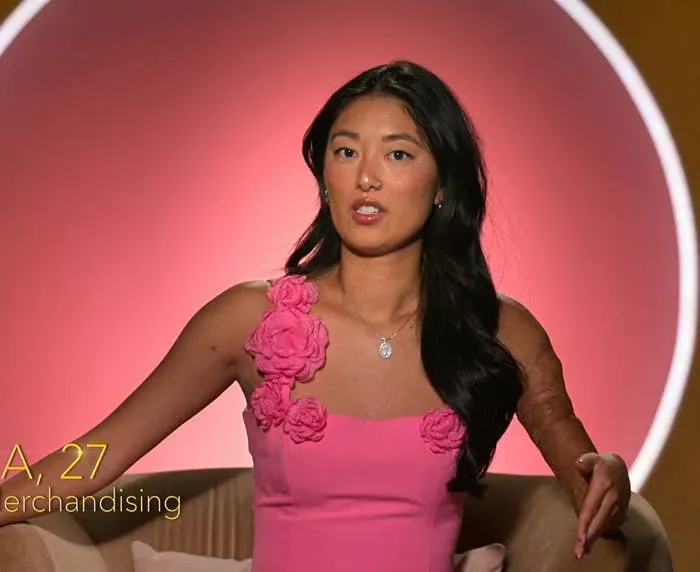
This reasoning is responded to in the same way by both men: this just means you’d make a great mom.
Despite her continued knowledge of ambivalence, her further relationship with her chosen partner, Mike, was centred around this conversation of children, so much so his vows at the alter was all about this question. When meeting her family, there was a push back on her family’s concern he is, inadvertently, pushing her to make a decision she would ultimately regret.
What is absolutely fascinating, to me, is the conversation around Emma, and her ambivalence about motherhood. The show, her potential partners, and the audience push a particular narrative about motherhood on to her, one which is a commonly told story in our contemporary society.
The Myth of Maternity
What makes a story a myth is how a society or an individual uses it to understand the world. This does not necessarily make a myth factually or historically true, nor does it always make the myth inherently morally good. There are lots of elements throughout the history of societies which are not morally sound but still heavily present in their worldly understandings - myths like white superiority for example.
The myth of maternity is a narrative frequently found in the societies of the United States and the United Kingdom (and many other areas of the world, but these are the two areas I know more closely). The myth of maternity is that women are bearers of children, and their whole body is determined to be as such - they are born with maternal instincts and wishes. Women are, at their core, mothers.
This story is one which forces alternative views on motherhood to be silenced. Women who are actively choosing to not have kids, for example, are treated as a problem. Women who have fertility issues are treated as less of women. Trans-women are demonised for being in the social category of women without the child bearing ability.
The story of the inherent mother is a multitude. It’s the story all women are maternal at their heart. It’s the story all women are yearning to bear children, and they are yearning to raise children. And, its the story when a woman isn’t sure about kids, its because she’s being silly. She’ll have the kids and make up her mind.

Part of the myth of maternity is that women never regret having children. They never question their choices. They never look back at the life they once lived. They never wonder what if. But this is definitely not true. This part of the narrative was communicated openly in Love is Blind, and bringing a shock and worry to the audience watching.
When meeting Emma’s family, Mike talks to Emma’s sister, who is a mother. She expresses concerns about pushing Emma, saying motherhood is really hard, and shouldn’t be taken on lightly. Mike pushes back with this narrative - but you don’t regret it, do you? Which is a complicated question to ask on reality television. What mother would openly admit to this on television? Nor is the answer ever so simple.
Emma’s sister has a beautiful responses. She loves her children, and does not regret the decision, but if she could live a completely new life, in a new space, she would enjoy the act of living for herself and not for her children.
This responses, I thought, was beautiful. But this has not been the experience of many watching the show. Emma’s ambivalence, and her sister’s response that living a life outside of children is just as valid and possible to lack regrets than one where children are here.
I have, in a video essay, talked a bit more about the choices to not have children, and how the myth of maternity directly affects them. But, today, I want to talk more specifically about the role of the ambivalent mother.
Ambivalence in Motherhood
Part of the problem of social categories is when people fall between categories, or when people move categories in a way which is not sanctioned by the social norms. There is the category of woman - the mother, the carer, the emotional labourer. There is also those outside. There is always the haggard wizened witch who never had family, living alone in a hut to avoid the social stigma of her loss. Women are either mothers, or are not. And those who are not are regretful, angry, despondent, and outside of society.
Which means the ambivalent mother, the one who is not fully in the definitions given to motherhood, is seen as somehow outside of social categories. They are monstrous.
Adrienne Rich wrote of maternal ambivalence, saying:
“My children cause me the most exquisite suffering of which I have any experience. It is the suffering of ambivalence: the murderous alternation between bitter resentment and raw-edged nerves, and blissful gratification and tenderness. Sometimes I seem to myself, in my feelings toward these tiny guilt-less beings, a monster of selfishness and intolerance.”
It is possible for a mother to suffer under the mantel of motherhood. To find things hard and troublesome, to think of what could have been. And yes, to regret. To wish things could have been different, in a different world and in a different way. And yet, this same person, can also love their child. They can care for these small baby faultless beings. They can love them with their entirety and struggle to think of life without them. Both can happen at the same time.
And for those who have not yet taken up the mantel - or, maybe, never will - these thoughts can also exist at the same time. These women on the fence can be both interested and emotionless. There can be disinterest.
But society, those watching Emma vacillate between two different positions which are not allowed to be moved within - one category even rejected from society entirely - are firmly against any view or conversation of the ambivalent mother.
And that’s because to admit there is a place for thoughts like Emma’s, for the ambivalent mother to exist, than we have to confront a fuller more complicated social conception: our ideas of motherhood are restrictive, controlling, and silence any outside opinion. Women are not allowed to speak openly about the actual toil and work involved in motherhood, and sometimes, you do regret the children you care for. These words are silenced, because it doesn’t fit the story.
So I, personally, welcome Emma’s ambivalence. And I hope she is never silenced.